
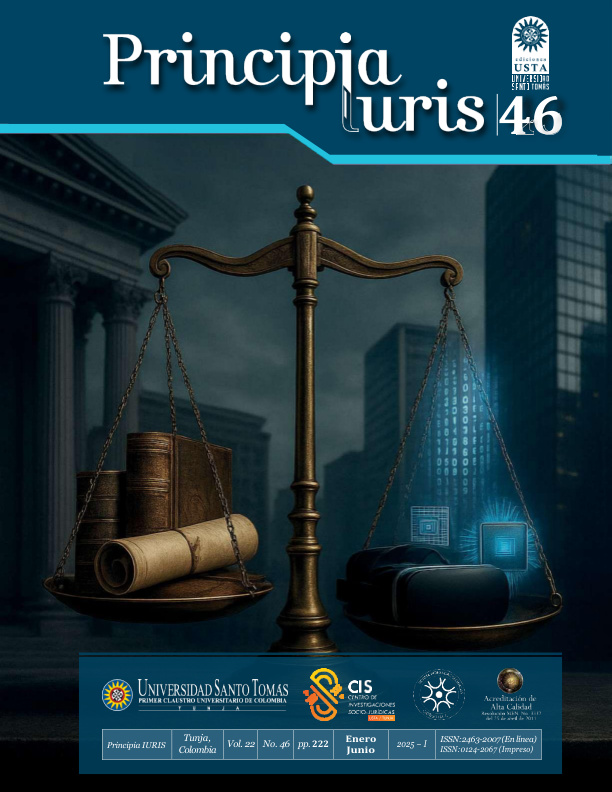
AI: Towards the dehumanization of the law
Article Sidebar
Main Article Content
Abstract
Article Details
Por medio de esta comunicación certifico que el artículo que estoy presentando para posible publicación en la revista institucional impulsada de la Facultad de Derecho de la Universidad Santo Tomás seccional Tunja, Principia Iuris, es de mi entera autoría, siendo sus contenidos producto de mi directa contribución intelectual.
Todos los datos y referencias a publicaciones hechas están debidamente identificados con su respectiva nota bibliográfica y en las citas que se destacan como tal.
Por todo lo anterior, declaro que el material presentado se encuentra conforme a la legislación aplicable en materia de propiedad intelectual, y por lo tanto, me hago responsable de cualquier reclamación relacionada a esta.
En caso de que el artículo presentado sea publicado, manifiesto que cedo plenamente a la Universidad Santo Tomás seccional Tunja los derechos de reproducción del mismo y accedo a las modificaciones que de forma se requieran para adaptarse a la estética de la revista. Como contraprestación de la presente cesión, declaro mi conformidad de recibir (2) ejemplares del número de la revista en que aparezca mi artículo.
References
Boden, M. A. (2016). Inteligencia artificial. Madrid, España: Turner.
Casacuberta, D. (s. f.). Sesgo en bucle: Alimentando la injusticia algorítmica. Recuperado el 1 de octubre de 2020, de http://lab.cccb.org/es/sesgo-en-bucle-alimentando-la-injusticia-algoritmica/
Comisión Europea. (2020). Libro blanco sobre la inteligencia artificial: Un enfoque europeo orientado a la excelencia y la confianza.
Corte Constitucional de Colombia. (2024, agosto 2). Sentencia T-9.301.656 de 2024.
Corvalán, J. (2018). Inteligencia artificial: Retos, desafíos y oportunidades. Prometea: La primera inteligencia artificial de Latinoamérica al servicio de la justicia. Revista de Investigações Constitucionais, 5(1), 295–316. https://doi.org/10.5380/rinc.v5i1.55334
Delgado, M. (1996). La inteligencia artificial: Realidad de un mito moderno. Granada, España: Universidad de Granada. https://digibug.ugr.es/bitstream/handle/10481/1270/1912512.pdf
Giménez, M. (2019). Inteligencia artificial y derecho penal. Actualidad Jurídica Iberoamericana, (10), 792–843. https://revista-aji.com/wp-content/uploads/2019/06/792-843.pdf
Larson, J., Mattu, S., Kirchner, L., & Angwin, J. (s. f.). How we analyzed the COMPAS recidivism algorithm. Recuperado el 21 de septiembre de 2020, de https://www.propublica.org/article/how-we-analyzed-the-compas-recidivism-algorithm/
Navarro Bonet, J. (2020). Algunas reflexiones sobre la viabilidad de la inteligencia artificial en el proceso penal. Revista Inmexius de Derecho Penal y Procesal Penal, (40), 1–12.
Pardo, P. (2018). Por qué la inteligencia artificial necesita clases de ética: “Hemos creado un Frankenstein”. Recuperado de https://atheneadigital.net/article/download/v20-2-ramirez/2084?inline=1
Rizer, A., & Watney, C. (2018). Artificial intelligence can make our jail system more efficient, equitable, and just. Texas Review of Law & Politics, 23(1), 181–227. https://doi.org/10.2139/ssrn.3129576
Santos, M. (2017). Regulación legal de la robótica y la inteligencia artificial: Retos del futuro. Revista Jurídica de la Universidad de León, 4. https://centros.unileon.es/derecho/files/2018/02/Revista-Jurídica-de-la-Universidad-de-León-núm.-4-2017.pdf
Serrano García, A. (2016). Inteligencia artificial. Madrid, España: RC.
Schwab, K. (2016). La cuarta revolución industrial. Barcelona, España: Debate.
Future of Life Institute. (2017). Asilomar AI principles. Recuperado el 20 de junio de 2017, de https://futureoflife.org/ai-principles/